
Reflections
Recently, I embarked on an interesting exercise: generating five minutes’ worth of questions on a single topic, “Should Teachers Ask Questions?”

This experience was both enlightening and amusing, as it made me realize just how many questions my mind could produce in such a short amount of time.
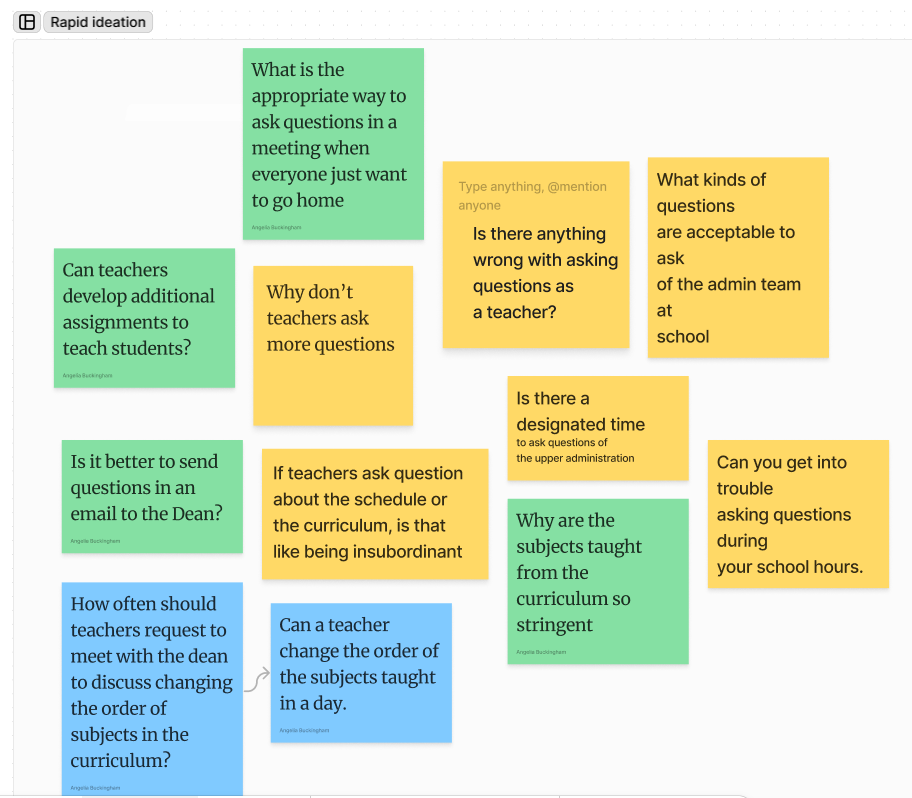
At first, the task seemed straightforward, but as I started, I couldn’t help but feel a bit silly. I knew that asking questions wasn’t just for students; teachers ask questions all the time to stimulate thinking and discussion. However, as the minutes ticked by, I found myself questioning my own questioning process. Could I really come up with enough questions to fill five minutes?
To my surprise, the process went very smoothly. I discovered that my mind was capable of generating an impressive number of questions—12, to be exact. This was a revelation to me, as I don’t usually ask so many questions on a single topic in such a short span of time.
This experience made me reflect on my students. Sometimes, I wonder where they come up with so many questions. Some of their inquiries are things they already know the answers to, yet they continue to ask. Unlike me, my students seem to have no limit to the number of questions they can pose on a single subject.
In contrast, my colleagues often don’t ask many questions. Instead, they tend to complain about various issues as if they are forbidden from asking why things are the way they are. This lack of curiosity can be frustrating, as it seems like asking questions should be a natural part of our profession.
As I completed the quickfire writing exercise it felt strange to have so many back-to-back questions within a single paragraph. It’s funny to notice that there were questions being asked about the questions I’ve asked. This meta-questioning seems normal in writing, but asking such questions out loud might make me appear to be silly, uninformed, or difficult.
A More Beautiful Question and a Wonderful Connection
Reading Warren Berger’s “A More Beautiful Question: The Power of Inquiry to Spark Breakthrough Ideas” has been an eye-opener, particularly in how it connects with my recent quickfire assignment experience. The first two chapters of Berger’s book delve into an intriguing question: why do we stop questioning? This question resonated deeply with me, especially after generating five minutes’ worth of questions about whether teachers should ask questions.
In his book, Berger explores how young children have no filters that prevent them from asking questions, even when the answers seem obvious to adults. This made me recall how my kindergarten students approach questioning in much the same way. They are relentless in their inquiries, often asking questions that seem redundant or obvious to us. However, their curiosity is boundless, and they are unburdened by the self-consciousness that plagues older individuals.
Before reading Berger, I had no idea that as we age, we tend to lose the desire for answers or become less curious because we fear how it may make us appear to others. Berger also examines some of today’s most profitable and necessary inventions and creations. These developments often stem from an observed need and begin with a simple question about a situation, circumstance, or genuine curiosity about the world.
The quickfire assignment stirred feelings in me that connected with those felt by some of Berger’s focused research. For instance, he recounts how a boating accident led one man to question why the science behind prosthetics was so far behind the science that put a man on the moon. This level of precise questioning was something I had never engaged in before. Doing so made me wonder about other things seemingly beyond my control.
Berger’s research brought these questions to the forefront of my mind, making me ponder why I don’t question things more deeply. He illuminates that young children are not concerned with their ability to control something and do not base their questions on such considerations. This gives them the freedom to think with an unobstructed mind.
Final Thoughts
I now feel that children are free to question openly because they are unconnected to the responsibilities of day-to-day life. Meanwhile, as a teacher, I remain encumbered by the weight of adult concerns.
Reference
Berger, W. (2014). A more beautiful question: The power of inquiry to spark breakthrough ideas. Bloomsbury.
